![Metalldetektor kaufen – Testsieger & Angebote [2026] Große Auswahl](https://test.bergemagnet.de/templates/metalldetektor/img/logo_head.png)
Gold panning, one of the last adventures of our time
Gold panning and gold mining in Germany has a very long tradition. However, a real "gold rush", such as at the Yukon, did not occur in Germany. Panning for placer gold in rivers and bodies of water or prospecting for gold in underground mines was hard work. Very few gold prospectors were able to make a living from it. The fascination of gold panning today lies in the combination of being outdoors in nature and experiencing it firsthand.
Gold Deposits in Germany
Where can you find the most rewarding spots for gold panning?
Bavaria, Baden-Württemberg, Thuringia, Saxony, Hesse, Rhineland-Palatinate, and North Rhine-Westphalia have proven gold deposits. Most finds are tiny gold flakes, but nuggets up to 10 grams have been discovered. There are many gold-bearing rivers in Germany; below are short lists of the most significant in each corresponding federal state.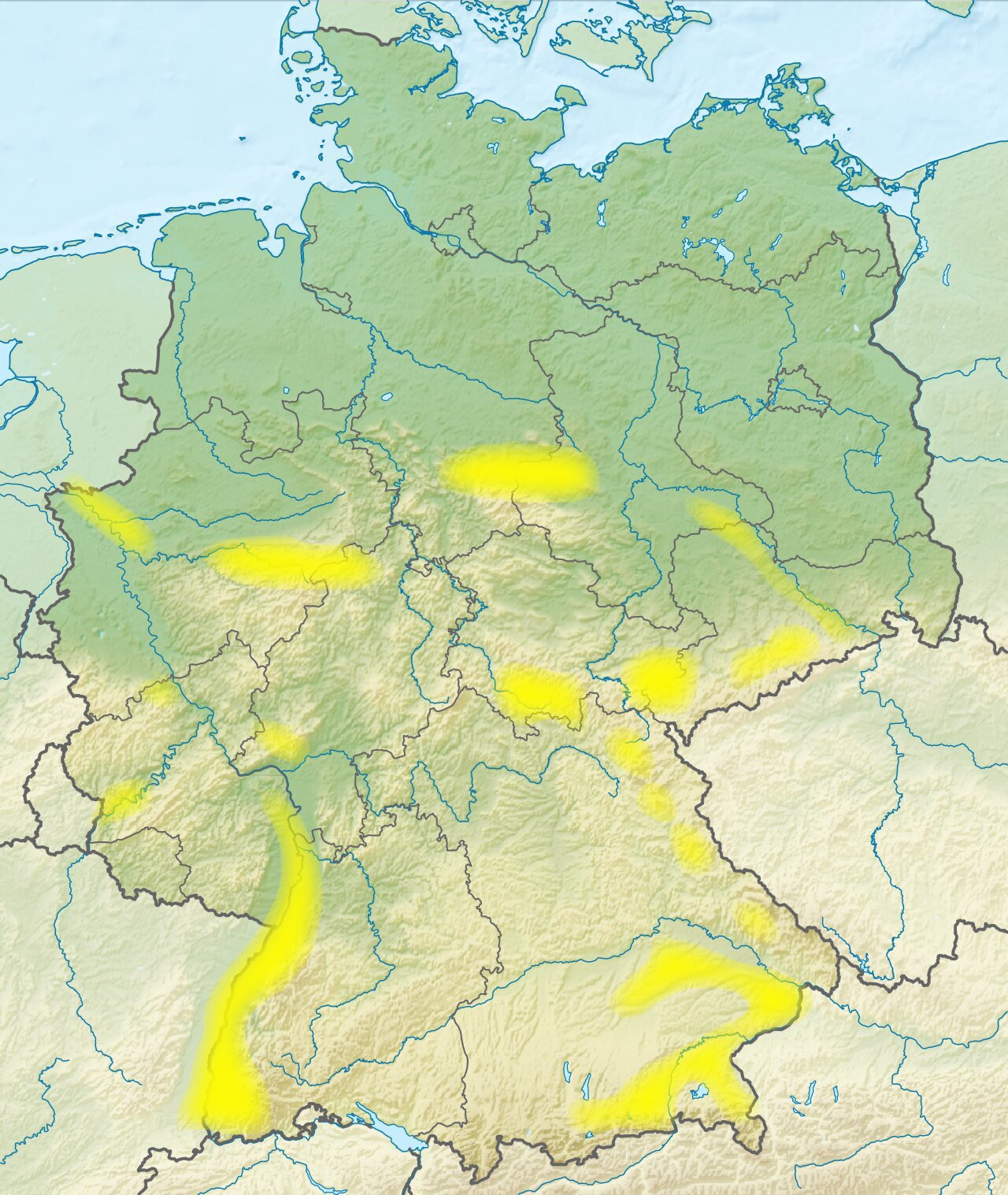 Bavaria: Danube, Salzach, Alz, Windach, Ammer, Amper, as well as Inn and Isar
Thuringia: Schwarza, Saale, Weiße Elster, Weida, Werra, Schleuse, Grümpen, Itz, Steinach, Rodach, Haßlach, Loquitz
Saxony-Anhalt: Aller
Lower Saxony: Wietze
Hesse: Eder
Saxony: Elbe, Göltzsch, Striegis
Baden-Württemberg: Rhine
Literature on Gold Panning
[products products_models='p1760,p1765,gold-in-sachsen,schade']How do you obtain the coveted gold?
In Germany, river gold is usually panned from the sediment with a gold pan and sluice.
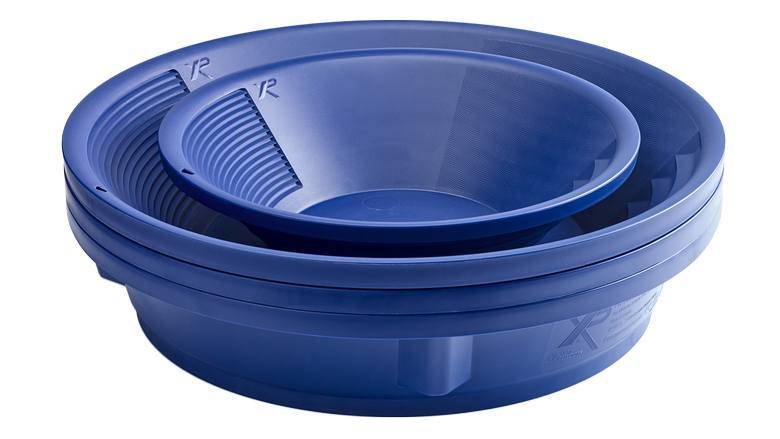
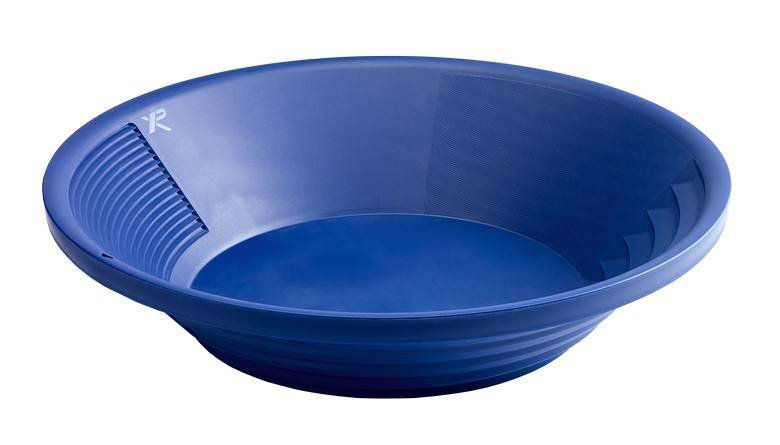
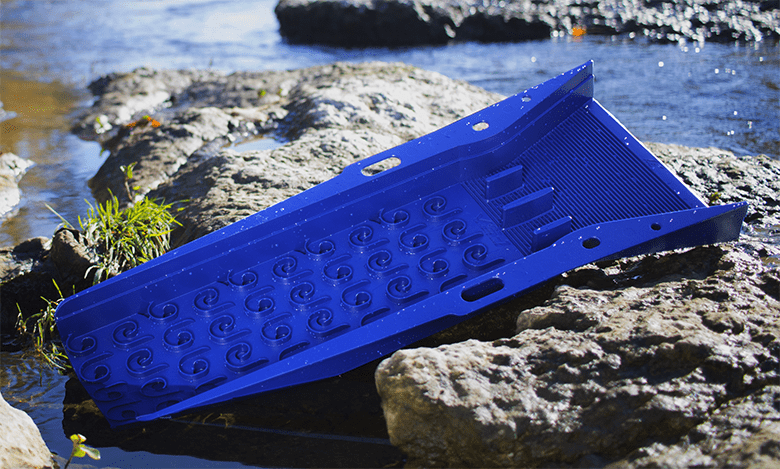
XP Gold Sluice VS1 - 40 vortices work together to filter out gold through an innovative dynamic process.
Where do I find gold in a stream/river?
Gold has a specific gravity of 19.3 g per cm³. Any obstacle in the river decreases the water’s velocity, causing the heavy gold to sink. Gold flakes do not collect in the fine river sand. They collect where there are coarse stones. If you wash the sand-gravel mixture several times, you obtain a fine sandy concentrate. The separation between gold and barren rock is achieved solely by weight. Each wash cycle should remove light material from heavy material.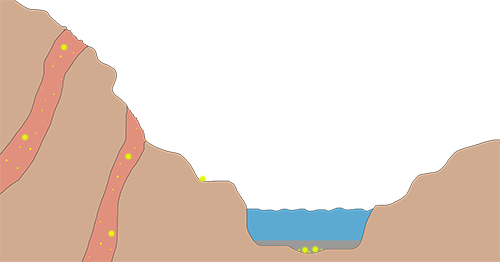
A gold-bearing vein that breaks to the surface will be slowly destroyed by erosion. The remnants can already accumulate into first deposits near the vein, even before they reach a stream or riverbed.

At river bends, material is removed at the cut bank, where the current is strongest. On the opposite point bar, it is deposited where the current slows. This is where the coveted gold is found.

Waterfalls, cracks, and eddy holes on river and stream beds form true folds in which the heavy gold can easily accumulate.
Checklist for Gold Panning
To make gold panning truly fun and successful, keep the following in mind:- Use the right equipment: Backpack, Shovel, Sieve, Wash pan, Sluice, Small trowel, Sniffer bottle, Sample jar, etc.
- Be sure to check before you leave when and where gold prospecting is permitted.
- Rubber boots including warm socks are absolutely necessary when gold panning at or in the stream/river.
- Warm clothes are necessary, too. Pack warm replacement clothing as well.
- Take food and sufficient drinks!
Gold Panning at the Stream
Rules for Gold Panning
- Do not leave any rubbish, take away any rubbish you find
- Refill excavated holes in the riverbed
- Do not dig into riverbanks
- Leave the panning site as you found it
Legal Considerations When Gold Prospecting
First of all, this is not legal advice. There is no law or even paragraph in Germany that outright prohibits or even mentions gold panning in rivers/streams.
Basically prohibited when gold panning:
- Entering nature reserves and private property
- Disrupting fishing & closed breeding seasons
- Removing trees and shrubs on the banks while digging for gold
- Handling gasoline, motor oil and batteries on the bank. Use of motor-powered highbankers (with combustion engine and electric).
Gold Detectors
[products products_models='DEUS2-24x13HF2-FMFRCWS6G,GM2000,ORX-ELLHFRCG-WSAg,AXI11g']Interesting Facts about Gold Deposits in Germany
According to Dr. Harald Elsner, an economic geologist from the BGR, there is still plenty of natural gold in Germany. This gold is mainly found in river sediments, as "flakes" or fine particles, and in rock. The estimates are based on studies and historical data. They refer to known but largely unexploited occurrences, not to undiscovered reserves. Germany has no large untouched gold mines. Extraction is often unprofitable but technically possible.
Key estimates:
Rhine (between Basel and Mannheim): Approx. 514 tons of gold in sediments (study by Tàrrega et al., 2008). An older estimate (Osann, 1927) was 52 tons.
Black Forest: Approx. 52 tons of gold bound with other minerals, requiring elaborate processing.
Other rivers (e.g. Elbe, Saale, Danube, Isar, Eder): smaller amounts, often in the range of a few kilograms to dozens of tons. Examples:
Schwarza (Thuringia): Historically, 4 tons mined; remaining potential not quantified, gold content up to 4 g/t in river sand.
Elbe (Saxony): Historically under 100 kg, current content approx. 16 mg/t gravel.
Bavarian rivers (e.g. Isar): Historically, approx. 50 kg, current content approx. 10 mg/t.
Eder: Historically, approx. 20 kg, current content approx. 22 mg/t gravel.
Mining deposits (e.g. old mines): Potential in regions like Goldkronach-Brandholz (Fichtelgebirge) with approx. 11.2 tons of gold (average 2–4 g Au/t ore) or Eisenberg (near Korbach) with 0.8–10 tons. Historically, approx. 102 tons of gold were mined from German ores. Remaining resources, however, are limited and often protected as nature reserves.
Overall estimate and notes:
Total hidden natural gold: The estimate is at least 500–600 tons, mainly in the Rhine. Globally, Germany has no large gold deposits. Compared to Australia (approx. 8,400 tons of unexploited reserves), the amounts here are small and mostly alluvial.
Current production: Only about 10 to several hundred kg per year, mainly as a byproduct of gravel extraction (e.g., from 2,700 gravel pits nationwide). Expansion might yield up to 1 ton/year if all gold-bearing rivers were worked.
Sources and limitations: These numbers are based on studies (e.g. Tàrrega et al., Osann) and BGR reports. They are estimates and depend on prices, technology, and environmental regulations. No significant undiscovered large deposits exist; most are known, though unmined.
The Metalldetektoren.de team wishes you "Good luck always"






Metalldetektor kaufen – Testsieger & Angebote [2026] Große Auswahl © 2026 | Template © 2009-2026 by modified eCommerce Shopsoftware